Elderly care
Know who is at the door before care begins.
Home care often starts with a stranger arriving at an older person's front door, sometimes arranged by a family member who lives hours away. An ID Verified Trust Request establishes who that person is, using government-issued identity documentation and a live face check: privately, before the first visit, and in a form the person answering the door can actually recognise.
✓ Trust Established
Mia is now a NoStranger.
You can now view the information Mia has chosen to share.

★★★★★ IDENTITY VERIFIED
Mia Alvarez
Approx. connection location: Wellington, NZ
Age
29
Gender
Female
First name
Mia
Last name
Alvarez
Identity Verified
These details were verified from a government-issued ID and checked against authoritative records, with a live face check confirming the person completing the verification matches the ID.
You only see what they chose to share. This code can't be used again.
Context
Why identity at the door matters for older people
Global estimates published by the World Health Organization.
1 in 6
people aged 60 and over were subjected to some form of abuse in community settings, according to WHO's review of 52 studies across 28 countries. That includes financial abuse, reported by 6.8%.
World Health Organization, 2017 estimate4%
of cases of abuse of older people are reported, on WHO's estimate, which is one reason families are often left to make their own judgements about who they let in.
World Health OrganizationThe gap
The person who opens the door is rarely the person who arranged the care.
Private care arrangements are usually made in a phone call or a message thread by an adult child, a sibling or a neighbour. The first physical contact, though, is between the carer and the older person, often alone, at a fixed weekly time, and often with a key or an alarm code involved.
That split is exactly where uncertainty lives. A name spoken over the phone does not help someone at the door decide whether the person in front of them is the expected carer, a replacement sent at short notice, or nobody legitimate at all.
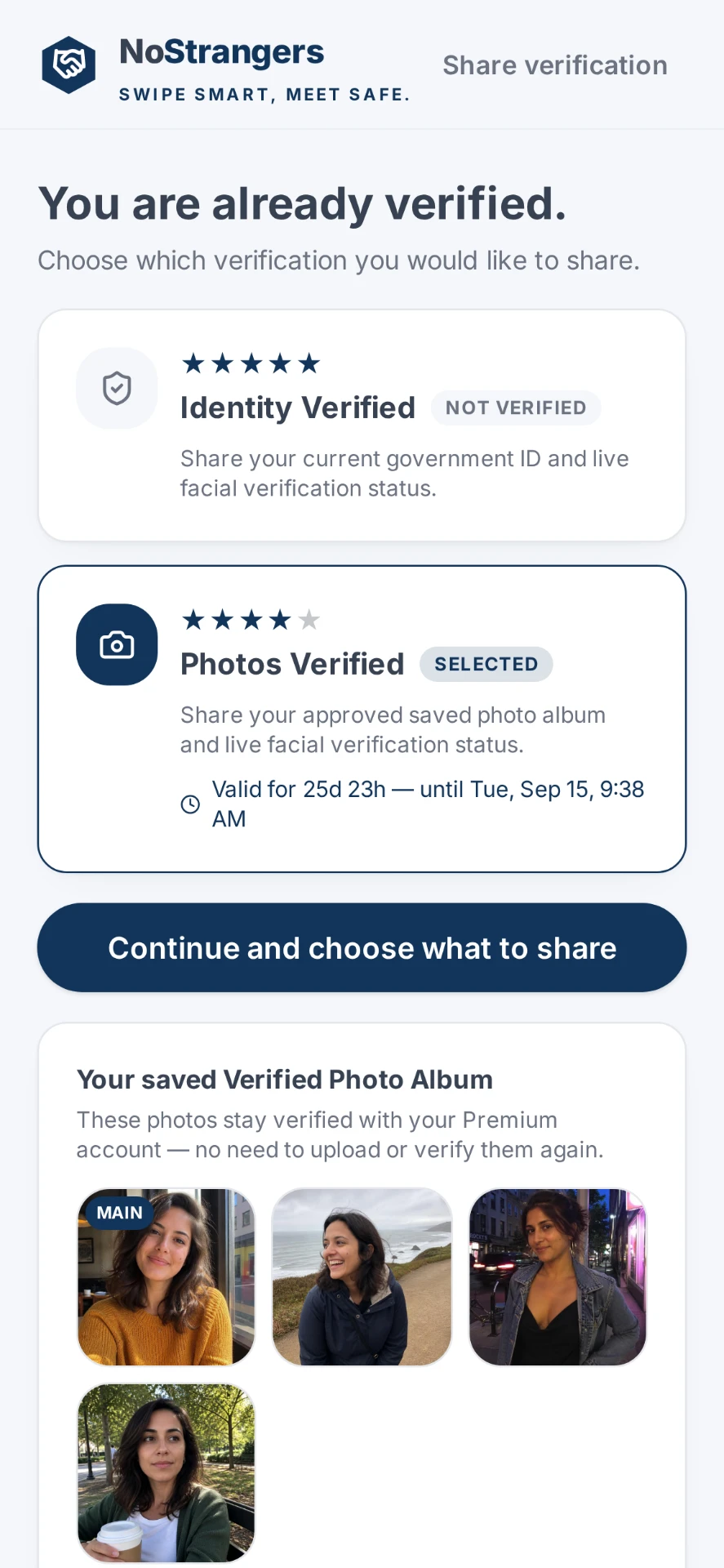
NoStrangers verifies identity, not credentials. ID Verified confirms government-issued identity documentation plus a live face check, with no ID documents changing hands. It does not confirm qualifications, registration, insurance, employment history or criminal record.
What it can do is turn an abstract name into a verified identity that the household has seen before the doorbell rings.
How it works
How NoStrangers works for a home-care arrangement
Set it up once, before the first visit, whoever in the family is organising things.
Send a Trust Request
Whoever is arranging care generates a unique code and sends it to the carer by message or email.
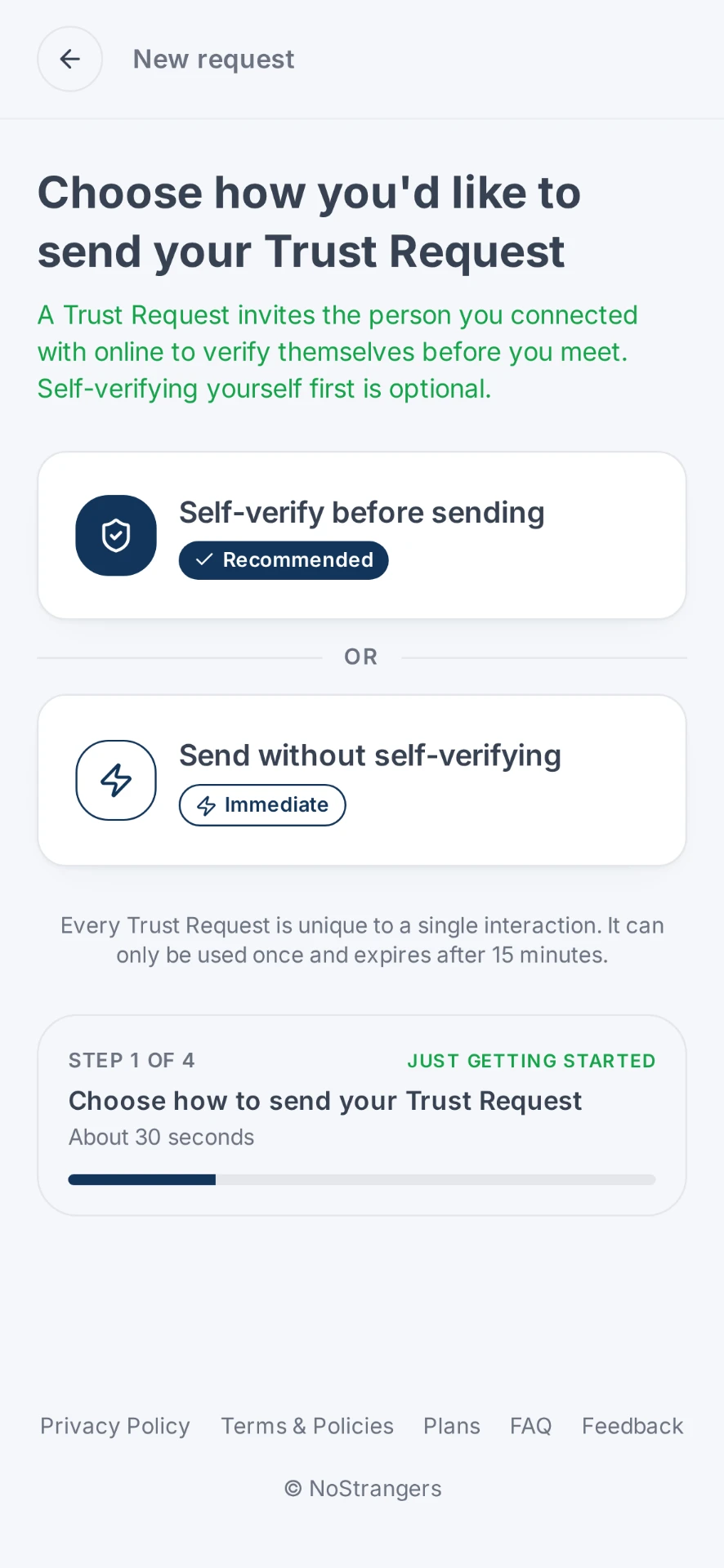
The carer verifies
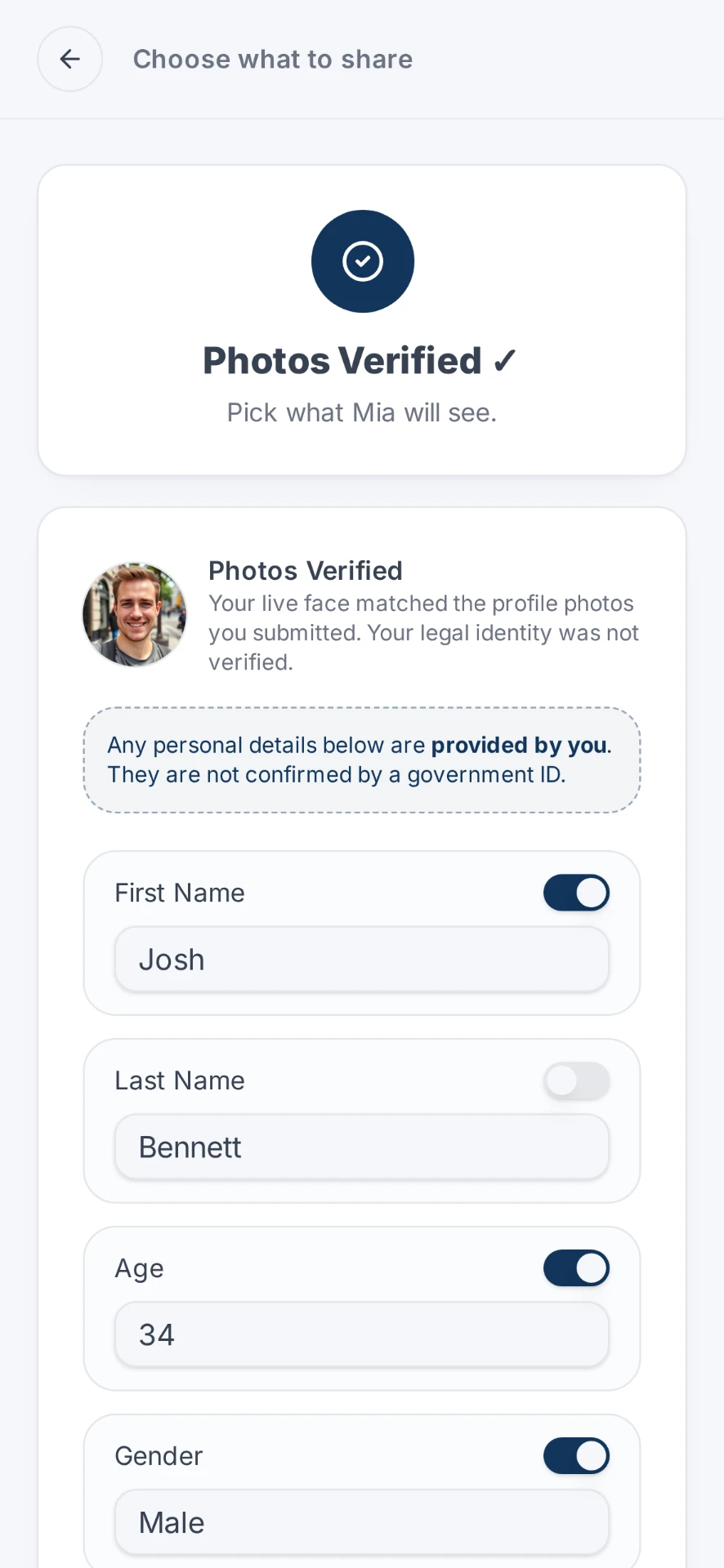
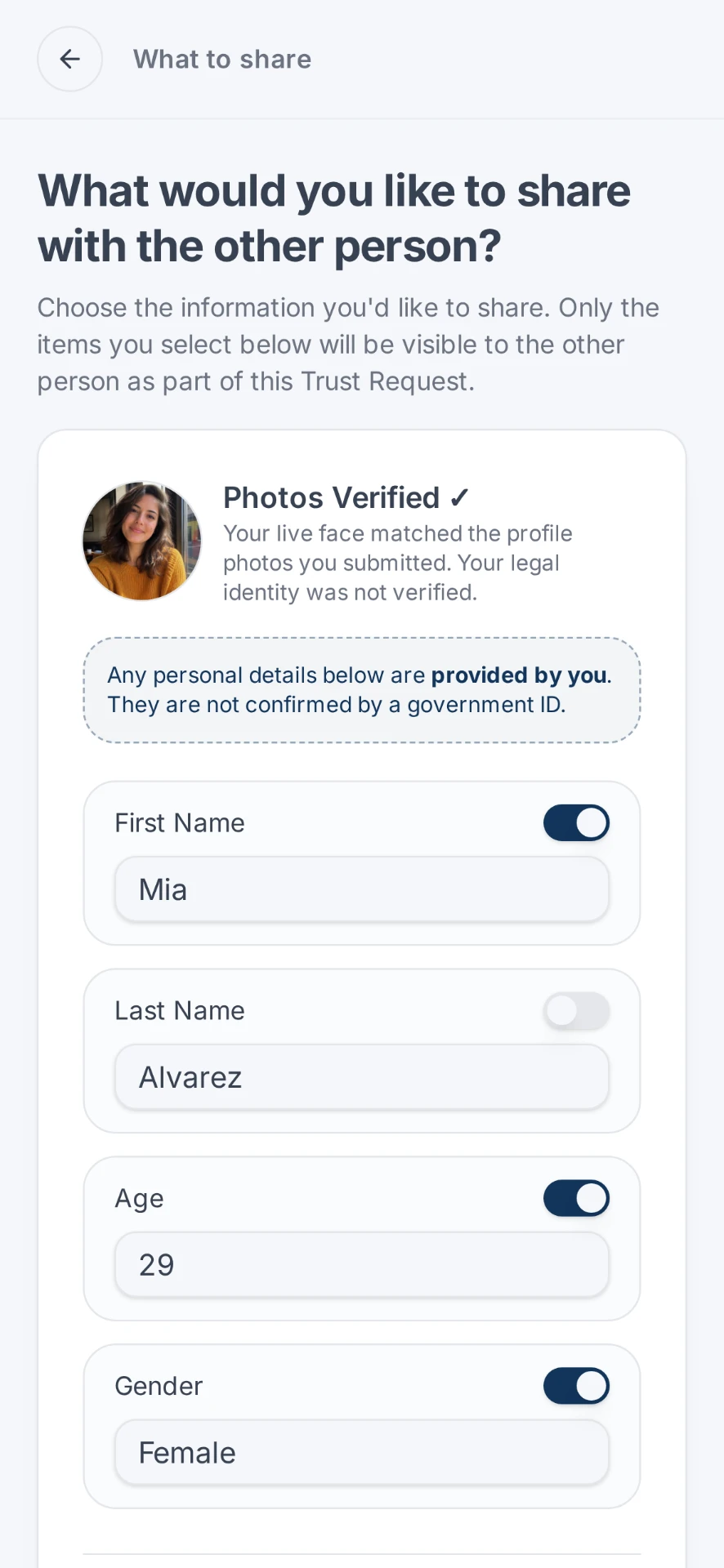
They complete ID Verified: government-issued identity documentation plus a live face check, and choose what to share back with the family.
Share the verified face with the household
Keep the verified result to hand, so the person answering the door already knows who to expect.
Privacy
Verify the carer. Keep the household's details private.
Only the match is shared. Your private information isn't. They don't see it. Neither do we.
Care arrangements accumulate sensitive information quickly: addresses, routines, medical notes, next-of-kin numbers. A Trust Request is narrower on purpose. The carer chooses what goes into their side, and you see only what they chose to share.
Carers benefit from the same restraint. Many are self-employed and asked repeatedly to send copies of identity documents to households they have never met, which leaves those documents scattered across strangers' inboxes.
More detail in our Privacy Policy.
When to use it
Where families use it
An independent carer found privately
A carer recommended in a community group or replying to a local ad, with no agency standing behind the introduction.
Care organised from a distance
You live in another city or country and will not be present for the first visit, or for most visits after it.
A replacement at short notice
The regular carer is unwell and someone else is coming instead. Verification can be done the same morning.
A relative living with memory loss
A face that has been seen and expected in advance is easier to trust than a name and a uniform.
Informal helpers and neighbours
Shopping, driving to appointments, medication reminders: unpaid or cash-in-hand arrangements with no paperwork at all.
Carers checking the household
A carer entering an unfamiliar home for the first time can ask the family to verify too, in the same request.
Be clear
What a Trust Request establishes before care starts
An identity step for the doorstep. Not a substitute for regulated checks.
It can help you
- Establish that a live person completed the verification process.
- Confirm, with ID Verified, government-issued identity documentation plus a live face check, so the household knows who is coming.
- Give a distant family member something concrete to pass on to the person at home.
- Let the carer verify without exchanging identity documents with you, and choose what to share back.
It doesn't
- Verify care qualifications, training, registration, insurance or employment history.
- Perform criminal-record or background screening of any kind.
- Assess quality of care, competence or intentions.
- Guarantee anyone's safety or predict future conduct.
FAQ
Elderly care identity questions
How can I check the identity of a carer coming to my parent's home?
Send a Trust Request before the first visit and ask for ID Verified. The carer completes government-issued identity documentation plus the required live face check, and chooses what to share back. You see that they have established who they are, and can pass that on to the person they'll be visiting.
Can an older relative recognise the carer at the door?
That is one of the most practical uses. Once a Trust Request is complete, the verified photo can be saved and shown to the person who will answer the door, so the face at the door is a face they are already expecting.
Does NoStrangers check a carer's qualifications or police record?
No. It does not verify nursing or care qualifications, training, registration, employment history, insurance or criminal record, and it is not a background-screening service. ID Verified establishes who the carer is, using government-issued identity documentation and a live face check, without either side handing over ID documents. Any regulated checks your country requires remain separate and necessary.
We're arranging care from another city or country. Does that work?
Yes. Everything happens in the browser, so an adult child overseas can send the Trust Request, see the result and share the verified details with the relative or a neighbour locally before anyone arrives.
Will the carer have to give us their identity documents?
No. ID Verified never means exchanging identity documents with each other. The carer chooses what goes into their side of the request, and you see only what they shared. Carers going into unfamiliar homes sometimes want the same reassurance about the household, and they can ask you to verify using the same request.
Is this useful for agency carers as well as independent ones?
Agencies normally handle their own identity checks and screening. A Trust Request is most valuable for privately arranged care: a carer found through a community group, a recommendation, a classified ad, or a replacement sent at short notice.
Does verification mean the carer is trustworthy?
No. It tells you that a live person completed verification and how they compare to the identity used. It cannot assess competence, intentions or conduct, and it cannot guarantee anyone's behaviour. References, required screening, supervision and regular contact all still matter.
Related use cases
Verify the carer before the first visit.
About 90 seconds, and the person at home knows exactly who to expect.