Freelancers
Work begins before the contract does. Know who's on the other end.
Freelance relationships form entirely online: a message, a call, a brief, an invoice. A client can send a Trust Request and ask a freelancer to become ID Verified before access is granted, files are shared or the first payment moves, and where you're both strangers taking on real risk, verifying each other is worth doing too.
✓ Trust Established
Mia is now a NoStranger.
You can now view the information Mia has chosen to share.

★★★★★ IDENTITY VERIFIED
Mia Alvarez
Approx. connection location: Wellington, NZ
Age
29
Gender
Female
First name
Mia
Last name
Alvarez
Identity Verified
These details were verified from a government-issued ID and checked against authoritative records, with a live face check confirming the person completing the verification matches the ID.
You only see what they chose to share. This code can't be used again.
The evidence
Work-related scams are a large and growing reported category
Figures published by the U.S. Federal Trade Commission.
$220m+
reported lost to job scams in the United States in the first half of 2024 alone, after reported losses more than tripled between 2020 and 2023.
U.S. Federal Trade Commission, December 2024~20,000
reports of 'task scams' in the first half of 2024, gamified fake-work schemes that barely existed in 2020, making up roughly 40% of job-scam reports that year.
U.S. Federal Trade Commission, December 2024The gap
Client and freelancer are each taking a stranger at their word, in opposite directions.
A freelancer commits time and often unpaid preparation to a client they know from a company name and an email signature. If that client evaporates after delivery, there is frequently no verified person to pursue, just a domain and a handle.
A client, meanwhile, hands over more than money: access to accounts, brand assets, customer data, internal documents, sometimes production systems. The person receiving it may have been introduced by an algorithm a week ago.
Platforms mediate some of this, but the most consequential conversations tend to migrate to email, chat apps and video calls, where the platform's checks no longer follow.
Identity is the one thing either side can quickly establish by sending a Trust Request, and where the risk runs both ways, both can. It does not assess anyone's competence or the quality of their work.
How it works
How NoStrangers works at the start of an engagement
Alongside the contract, before access and before the deposit.
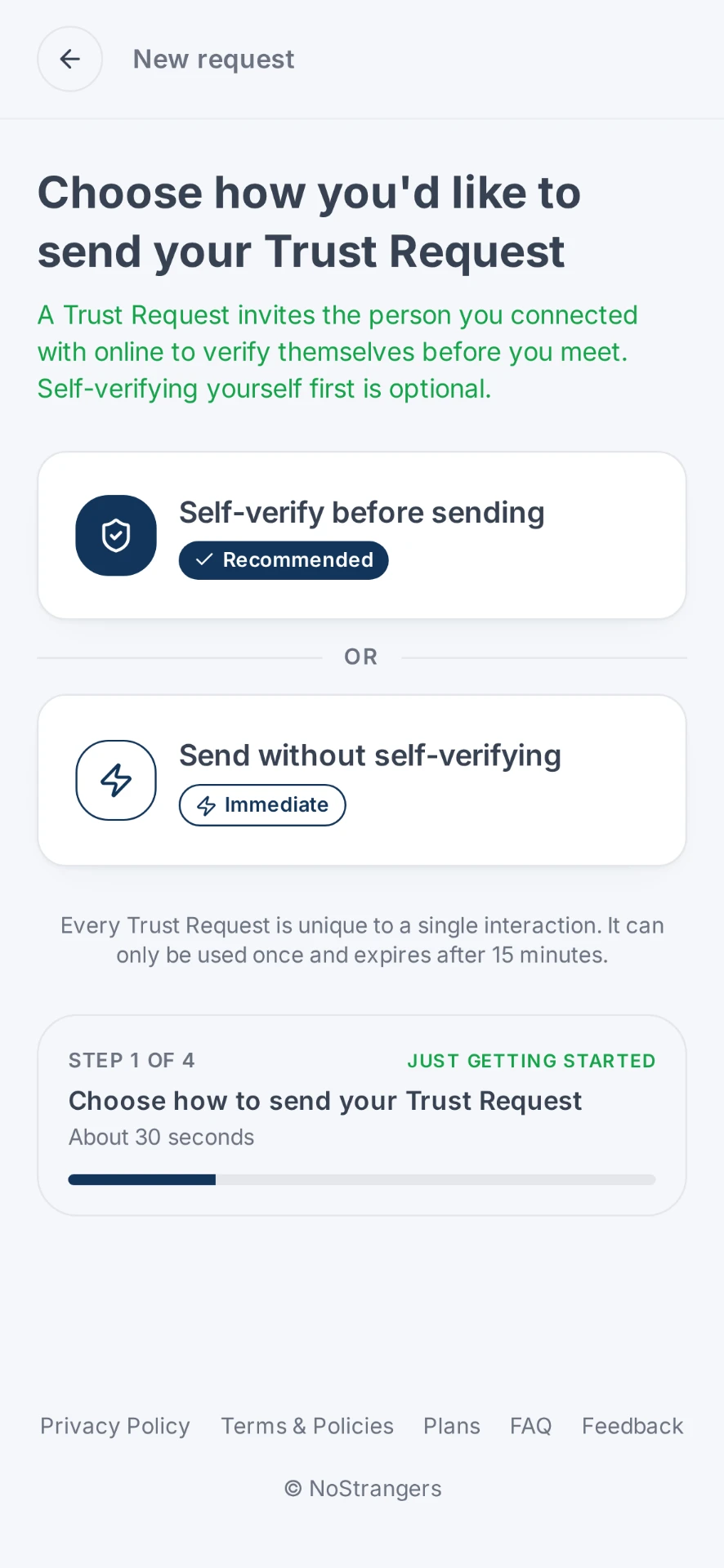
Send a Trust Request
Usually the client sends it, with the brief or the proposal, but a freelancer can send one just as easily.
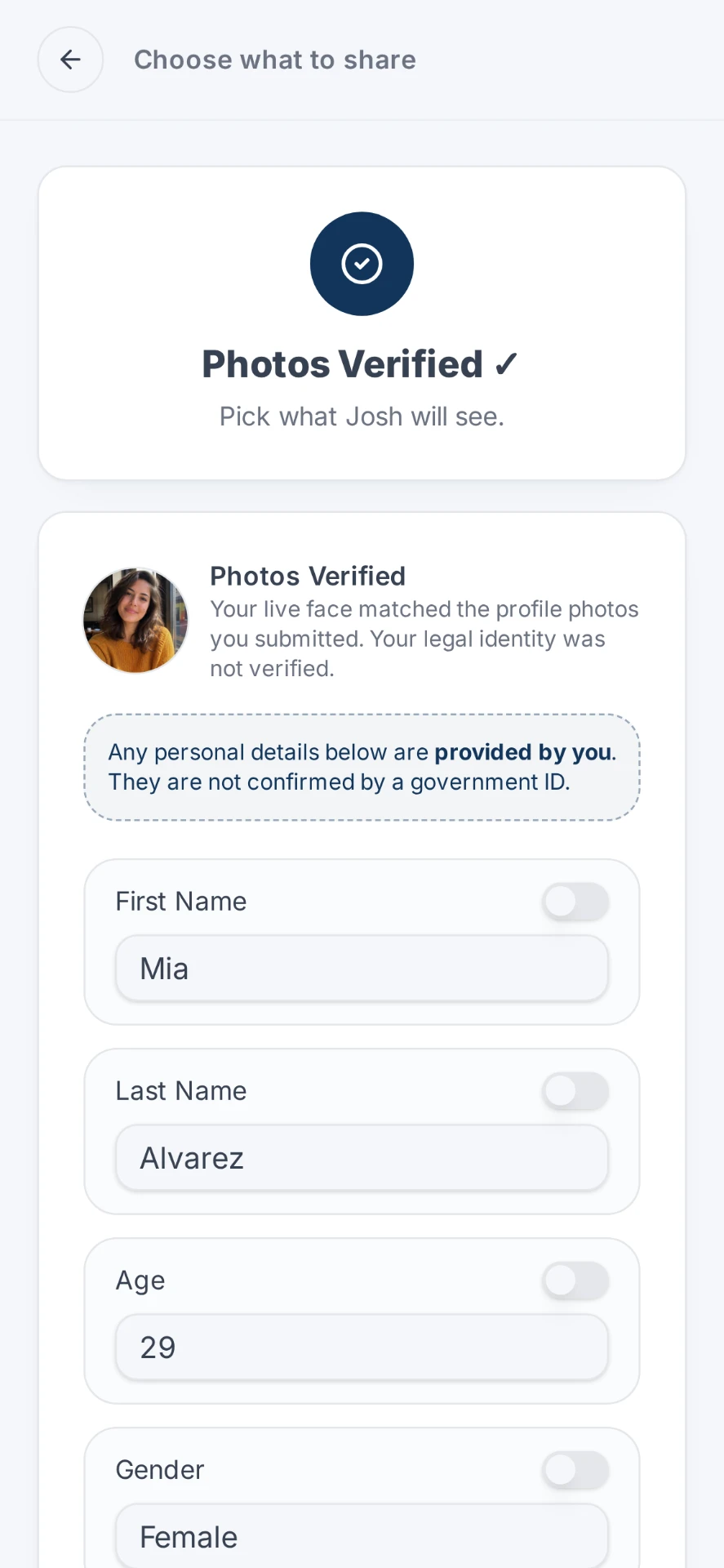
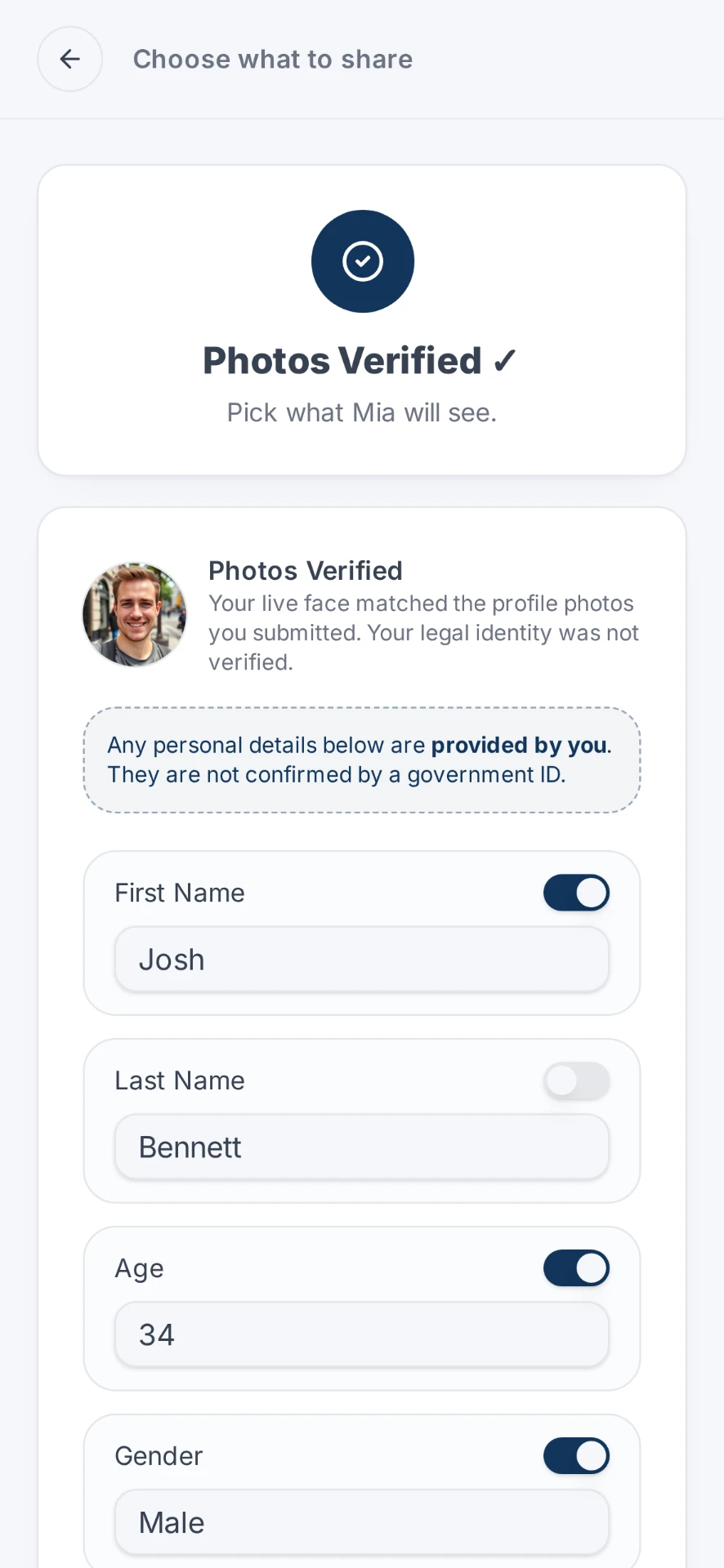
They verify
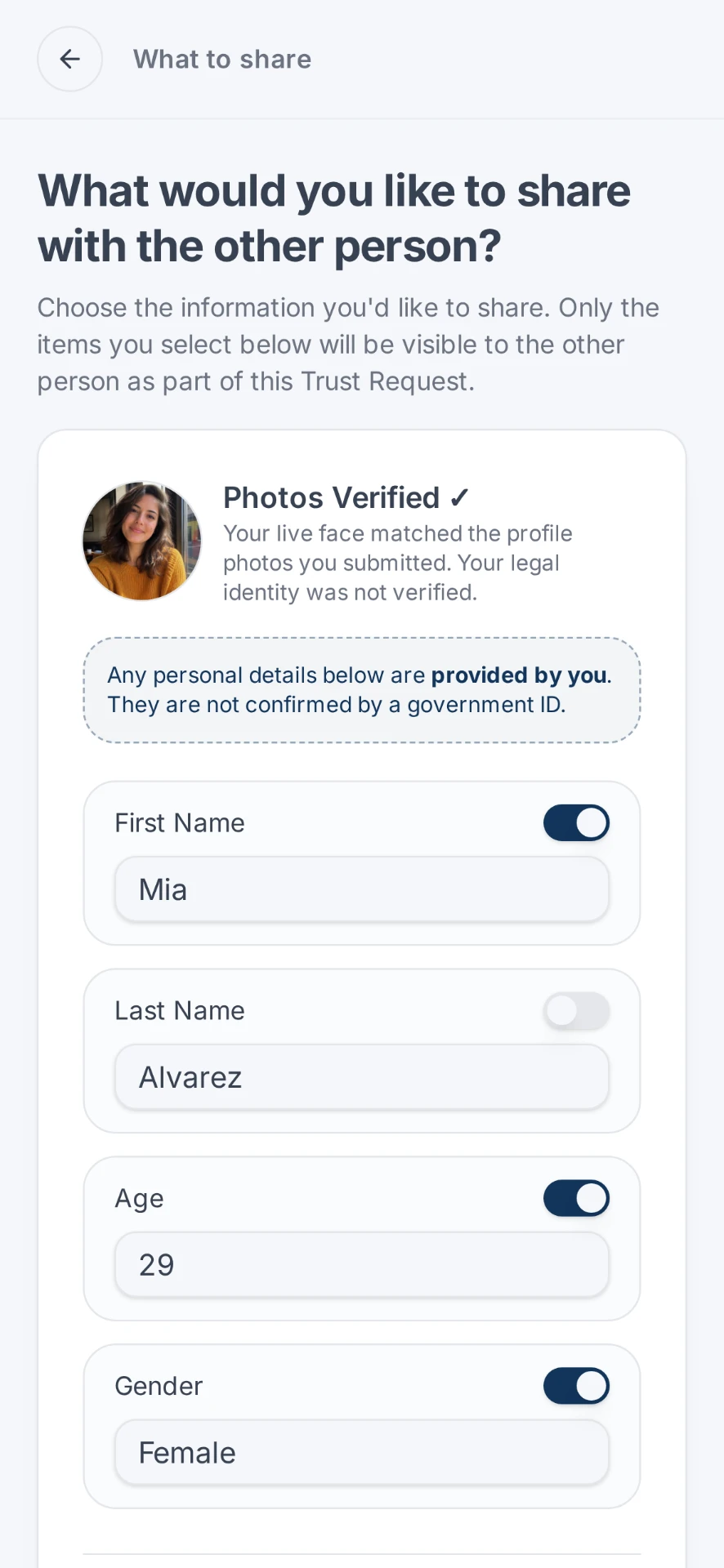
The other person completes an ID Verified check, government-issued ID plus a live face check, and chooses what to share back. No ID documents change hands directly. For a longer engagement or one where you're both strangers, it's worth verifying each other rather than just one direction.
Agree scope and terms
With identity confirmed, agree scope, milestones and payment terms as normal.
✓ Trust Established
Mia is now a NoStranger.
You can now view the information Mia has chosen to share.
★★★★★ IDENTITY VERIFIED
Mia Alvarez
Approx. connection location: Wellington, NZ
Age
29
Gender
Female
First name
Mia
Last name
Alvarez
Identity Verified
These details were verified from a government-issued ID and checked against authoritative records, with a live face check confirming the person completing the verification matches the ID.
You only see what they chose to share. This code can't be used again.
Privacy
Prove you're real without publishing your paperwork.
Only the match is shared. Your private information isn't. They don't see it. Neither do we.
Independent workers are asked for identity documents constantly: onboarding forms, contractor portals, one-off clients who want 'a copy of your ID for our records'. Every copy is a small permanent risk.
A Trust Request is deliberately narrower. Whoever completes it chooses what goes into their side, and the sender sees only what was shared back, nothing more.
More detail in our Privacy Policy.
When to use it
Points in a freelance relationship where it helps
A first client from a cold approach
An enquiry arrives by DM or email from someone with no mutual contacts and a fast-moving brief. Send a Trust Request before you commit any time.
Moving off the platform
The conversation shifts to email or a chat app, taking it outside the platform's protections.
Before granting access
A contractor is about to receive logins, admin rights, brand assets or customer data.
Deposits and large invoices
Money is about to move in either direction. Whoever is more exposed can ask the other to verify, or both can if the amount justifies it.
Long remote engagements
Months of work with someone you'll never meet, across time zones and jurisdictions: worth verifying each other, not just one side.
An offer that feels too good
Unusual generosity, urgency or an odd payment route: verify the person before you engage further.
Be clear
What a Trust Request establishes in freelance work
Identity, for whoever completes the check. Not capability, and not a guarantee of payment.
It can help you
- Establish that a live person completed an ID Verified check.
- Confirm who someone is, without either party exchanging ID documents.
- Let a client verify a freelancer, a freelancer verify a client, or both, independently of any platform.
- Give you a verified counterpart before access, deposits or delivery.
It doesn't
- Verify skills, qualifications, certifications, portfolios or references.
- Judge the quality, originality or timeliness of anyone's work.
- Confirm that a company, brief or contract is legitimate, or that an invoice will be paid.
- Replace written contracts, staged payments and your own due diligence.
FAQ
Freelance verification questions
How can a freelancer verify a new client?
Send a Trust Request before you start work or accept an unusual payment arrangement. The client completes an ID Verified check, government-issued ID plus a live face check, and chooses what to share back. It establishes that a real, identifiable person sits behind the brief, without either of you exchanging ID documents. You don't need to verify yourself to ask for this.
How can a client verify a freelancer?
The same way: send the Trust Request and the freelancer completes it. This matters when you're about to grant access to accounts, documents or systems to someone you've only met over email. If it's a longer or higher-trust engagement, the freelancer can send a Trust Request of their own too.
Does this tell me the freelancer can actually do the work?
No. NoStrangers does not verify skills, qualifications, certifications, portfolios, references or previous clients, and it cannot judge the quality of anyone's work. Portfolio review, a paid trial task and references are still how you assess capability.
We're working through a freelance platform. Is this still useful?
Sometimes. The common risk is that a conversation begins on a platform and moves to email or a messaging app, where the platform's identity checks, escrow and dispute process no longer apply. A Trust Request is independent of any platform, so it still works there.
What about fake job or contract offers?
A suspiciously generous brief, a request to pay for equipment or 'onboarding', or pressure to move quickly to an unusual payment method are all worth pausing over. Verification confirms a live person is behind the offer. It does not confirm the offer itself is legitimate.
Do I need to send my ID to a client?
No. Each side chooses what to share and sees only the other's selection. Freelancers in particular are asked for identity documents constantly; a Trust Request is designed to avoid scattering copies of them.
Does verification guarantee I'll get paid?
No. It gives you a verified identity to deal with and, if things go wrong, a name you have actually confirmed. Contracts, deposits, staged payments and invoicing terms remain your real protection.
Related use cases
Verify before the first milestone.
About 90 seconds to complete, sent by whichever side wants the assurance first.