Dating & meeting safety
How to safely meet someone from a dating app
Meeting someone you've only known through a screen can be exciting. It can also feel a little strange when you stop and think about how little you may actually know about the person you're about to meet.
Most first dates and meetups are completely uneventful. You don't need to approach every new person as a threat.
A few simple precautions can give you more information and more control before you go.
Before you meet, make sure the person adds up
You don't need to investigate someone's entire life before going on a date.
But there is a difference between knowing things about someone and knowing that the person behind the profile is actually the person you've been talking to.
Look at their profile as a whole. Do their photos seem consistent? Does what they've told you broadly match what you can see? Have you spoken live or had a video call?
If something doesn't add up, deal with that before you meet rather than hoping it will make sense when you get there.
If you're concerned the profile itself might be fake, read How to tell if you're being catfished.

Consider verifying each other first
If you're going to meet somebody in person, you can ask them to verify who they are beforehand.
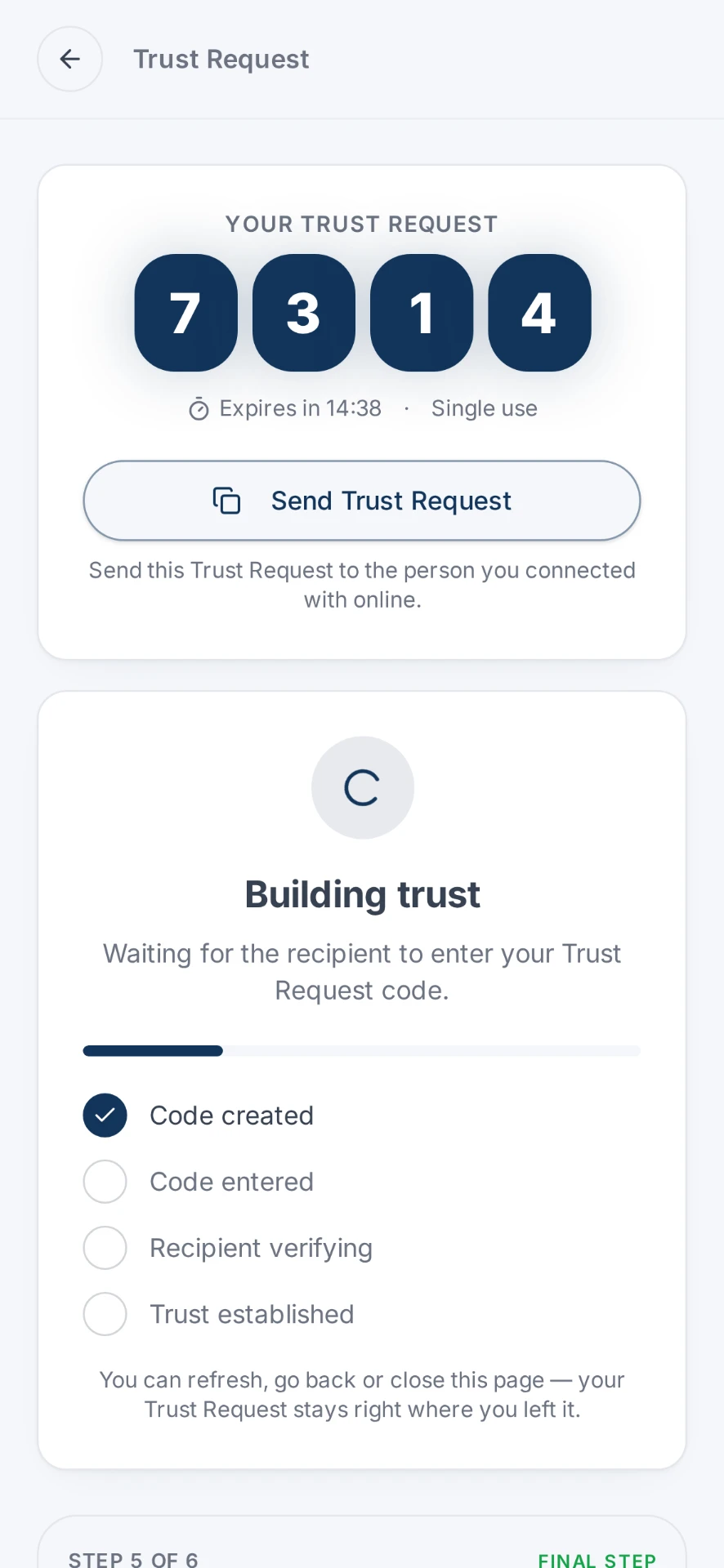
A NoStrangers Trust Request lets two people privately verify before meeting.
You can send someone a Trust Request and ask them to complete a live verification. They choose what verified information they want to share with you, and you can verify yourself too.
It gives both people a way to establish more about who they're meeting without sending identity documents or other sensitive information directly to each other.
Verification is not a guarantee that somebody is safe. It simply gives you more reliable information than a profile alone.
For a closer look at the process, read How to verify someone you met online before meeting.
Request sent
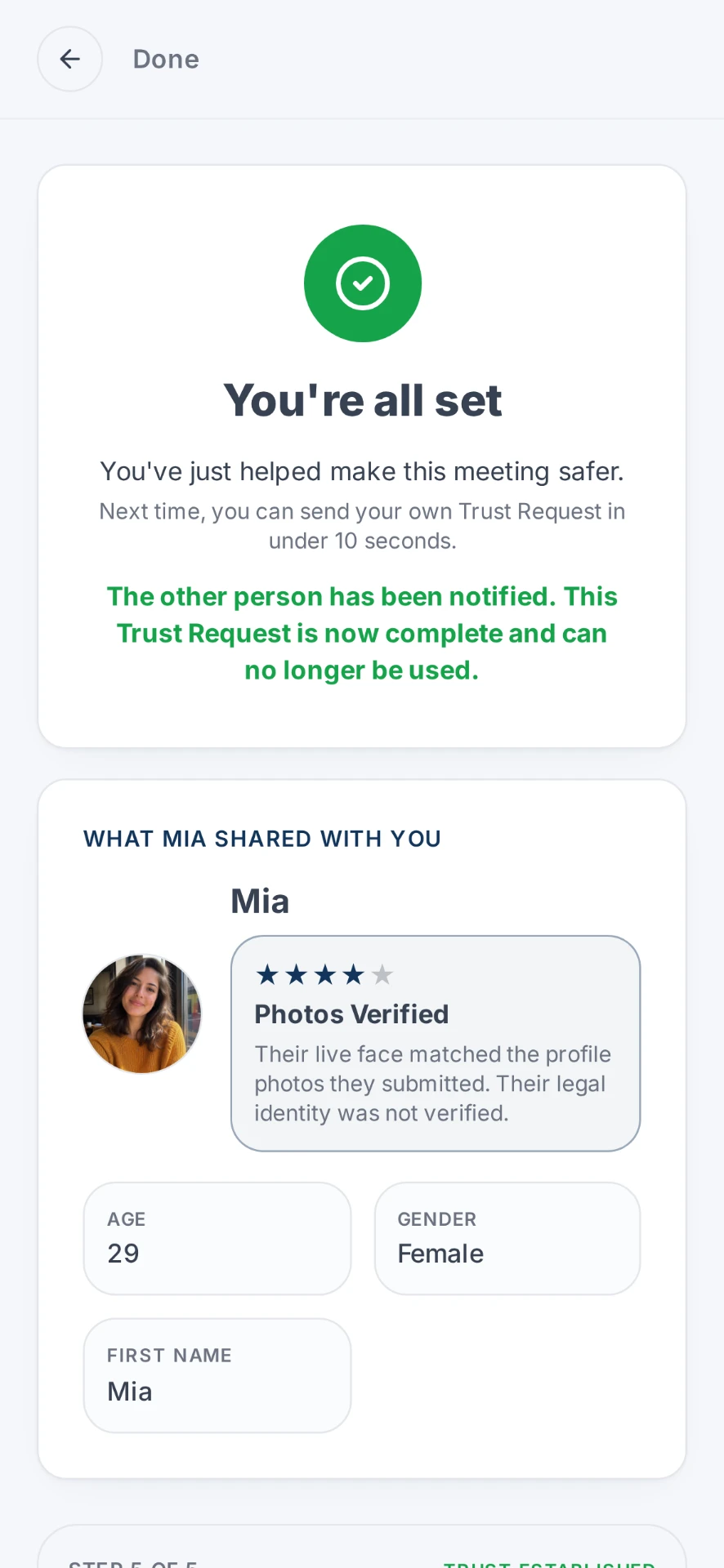
Request returned
Tell someone where you're going
Let somebody you trust know that you're meeting someone new.
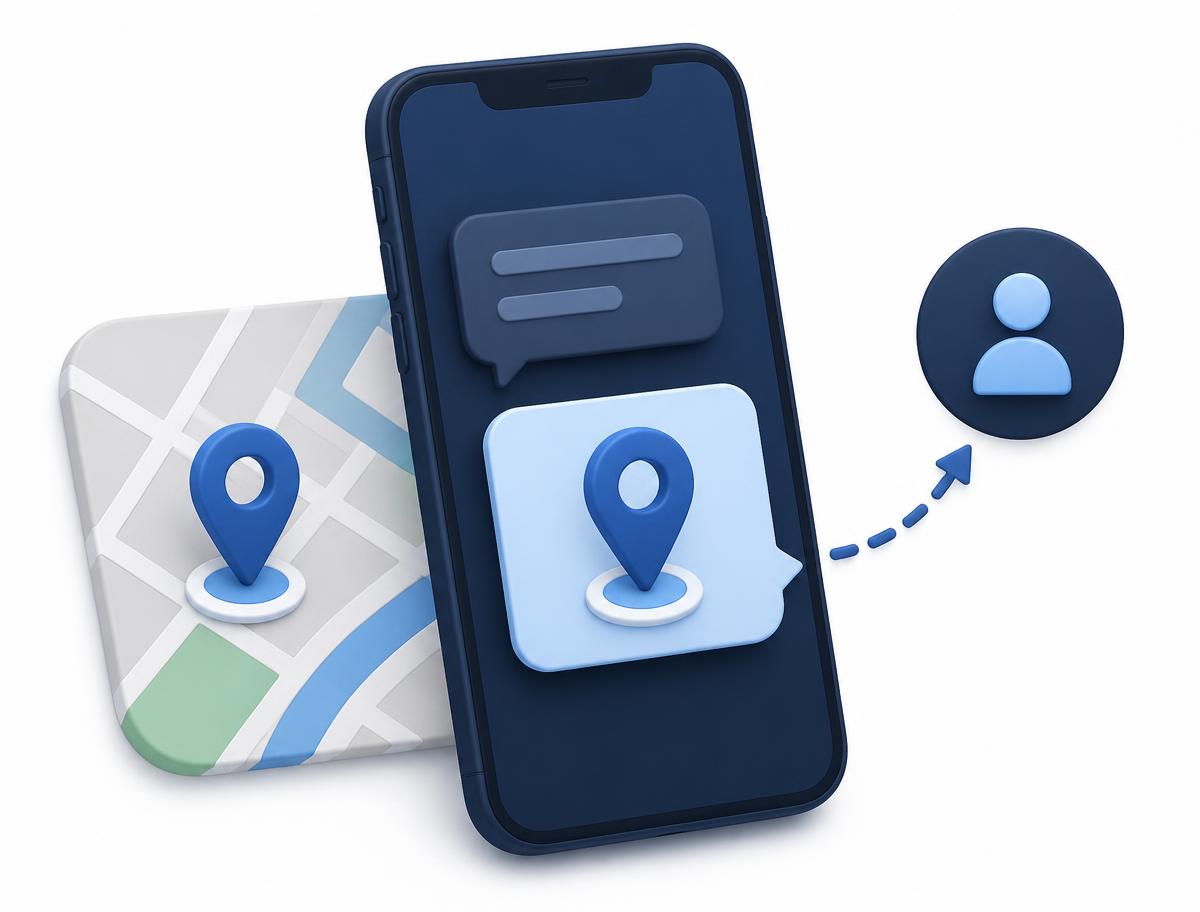
Tell them where you're going and roughly when you expect to be finished. If it makes sense, arrange to message them afterwards or share your location with them for the duration of the meeting.
It doesn't need to be dramatic. A simple message to a friend telling them where you'll be can make a difference if something doesn't go to plan.
Think about where you're meeting
For a first meeting, a public place can give both people an easy way to arrive, spend some time together and leave independently.
A café, bar, restaurant, busy park or other populated location can work well.
Meeting at someone's home is different. It gives you fewer options if you arrive and immediately feel uncomfortable.
That doesn't mean you should never meet someone privately. It means it's worth thinking about the setting before you go rather than making that decision automatically.

Keep control of how you get there and leave
Where possible, have your own way home.
Driving yourself, using public transport, arranging a taxi or rideshare, or having another plan you control means you aren't dependent on the person you've just met to leave.
If they picked you up, know how you would get home without them.
It's a small thing that can give you a lot more control over the situation.

Be careful about giving out your home address
There are plenty of situations where meeting at someone's home makes sense. But once somebody knows where you live, you can't take that information back.
If you aren't comfortable giving a new person your address yet, meet somewhere else first.
The same applies to information such as exactly where you work or places you visit at predictable times.
You can always share more later.
Alcohol and drugs can change the situation
If drinking or drugs are likely to be part of the meeting, remember that they can affect judgement and make it harder to respond if the situation changes.
Know what you're taking, keep an eye on your own drink and avoid becoming dependent on someone you've just met to get home safely.
You don't need to avoid having a good time. Just don't give away all of your options in the process.
What if the person who arrives isn't who you expected?
You don't have to stay.
If the person looks substantially different from who they presented themselves as, another person turns up unexpectedly, the meeting location suddenly changes, or something about the situation feels wrong, you can leave.
You don't owe somebody politeness at the expense of your own comfort.
Move somewhere public if you need to, contact someone you trust and arrange your own way home.
You can change your mind at any point
Agreeing to meet somebody doesn't commit you to anything else.
You can change the location. You can decide not to go. You can leave five minutes after arriving. You can change your mind about going somewhere else afterwards.
The same applies to both people.
A first meeting is simply a chance to meet.
After the meeting
If you told somebody where you were going, let them know you're finished and okay.
If the meeting went well, great.
If something happened that made you uncomfortable, don't feel obligated to keep talking to the person afterwards. You can block or report them through the platform where you met if appropriate.
If something serious happened or you believe you're in immediate danger, contact the appropriate emergency service or local authority.
The aim isn't to make dating feel dangerous
Meeting new people always involves some uncertainty. Dating apps didn't invent that.
What online dating changed is that it's now easy to build familiarity with somebody before you've ever been in the same room.
That familiarity can feel like knowing them.
Sometimes it is worth separating the two.
Take a few sensible precautions, establish who you're meeting, keep control of your own plans and then get on with the reason you're meeting in the first place.
If they're coming to your place instead, see is it safe to give someone you met online your address?
Fake profiles have also been used to arrange real-world attacks, see When a fake dating profile becomes a real-world threat.
More safety guides are available in the Safety section.
Real stories, cases and guidance
Reporting and official guidance from external publishers. Links open in a new tab.
New Zealand Police
Auckland Police remind the public to think of safety and their responsibilities when using dating apps this summer
An Auckland Police reminder about personal safety when arranging dating app meetings.
Read on New Zealand PoliceNew Zealand Police · 12 May 2026
Police urge caution to dating app users, Southland
Southland Police urge dating app users to take care after reported offending.
Read on New Zealand PoliceNew Zealand Police
Safety advice
Police guidance for dating websites, covering fake identities, photos, private information and meeting in person.
Read on New Zealand Police1News · 15 Aug 2026
Man lured via fake dating app profile in suspected homophobic attack
A Christchurch man describes being attacked after arranging a meeting through a Grindr profile.
Read on 1NewsRNZ / Open Justice · 19 Dec 2025
Grindr attackers Thomas Bull, Ethan Jeffs and Patrick Moloney sentenced in the Tauranga District Court
Court reporting on the sentencing of three men over Grindr-arranged assaults in Tauranga.
Read on RNZ / Open JusticeABC News · 9 May 2025
Criminals used fake profiles on gay dating apps to lure robbery victims, police allege
Victoria Police allege fake dating app profiles were used to lure and rob victims.
Read on ABC NewsABC News · 8 Aug 2024
Dating app Grindr 'in communication' with police following three alleged homophobic attacks in Canberra
Grindr responds to alleged Canberra attacks and displays safety information to users.
Read on ABC NewsUK Crown Prosecution Service · 18 Sept 2024
Men convicted of dating app robbery
The CPS reports convictions after fake Grindr profiles were used to lure victims in Birmingham.
Read on UK Crown Prosecution ServiceeSafety Commissioner
Online dating
Australian eSafety guidance on staying safe when dating online.
Read on eSafety CommissionerCNA · 2 Jan 2026
'Everyone feels scary': How catfishers are turning some singles off dating apps
Reporting on how fake profiles are eroding trust for people using dating apps.
Read on CNA