P2P sales
Establish who you're dealing with before you meet, transact or grant access.
Plenty of buying and selling happens with nothing in between: a comment thread, a group post, a direct message, a classified ad, a word-of-mouth introduction. ID Verified adds the one check those deals usually lack: a way to establish who is actually on the other end, using government-issued identity documentation and a live face check.
✓ Trust Established
Mia is now a NoStranger.
You can now view the information Mia has chosen to share.

★★★★★ IDENTITY VERIFIED
Mia Alvarez
Approx. connection location: Wellington, NZ
Age
29
Gender
Female
First name
Mia
Last name
Alvarez
Identity Verified
These details were verified from a government-issued ID and checked against authoritative records, with a live face check confirming the person completing the verification matches the ID.
You only see what they chose to share. This code can't be used again.
The evidence
Deals that begin in social feeds carry outsized reported losses
Figures published by the U.S. Federal Trade Commission.
30%
of people in the United States who reported losing money to a scam in 2025 said it started on social media, with reported losses of $2.1 billion, around eight times the 2020 figure.
U.S. Federal Trade Commission, 2026 Data Spotlight70%
of U.S. consumers who were contacted by a scammer through social media in 2024 reported losing money, the highest loss rate of any contact method, totalling $1.9 billion.
U.S. Federal Trade Commission, March 2025The gap
Direct deals run entirely on the goodwill of two strangers.
A private sale has no intermediary by design. That is part of the appeal: no fees, no rules, no waiting for a payout. It also means there is no account history to read, no ratings to weigh, no escrow holding the money and nobody to appeal to afterwards.
What people substitute instead is social proof: a friendly profile, a shared group, mutual acquaintances, a photo or two. Those signals are cheap to fabricate and easy to borrow from someone else's life.
The deal then usually ends with one of the riskiest steps either party takes all week: a bank transfer to a stranger, or a stranger arriving at a home address to collect.
NoStrangers is not escrow, insurance or a payment service, and it says nothing about the goods.
What ID Verified adds is a way to establish who each side actually is, using the identity documentation and live face check they chose to complete, without either of you handing documents to the other. If your deal started on a marketplace platform, our Marketplace page covers that situation specifically.
How it works
How NoStrangers works in a direct sale
After the price is agreed, before any money or address is shared.
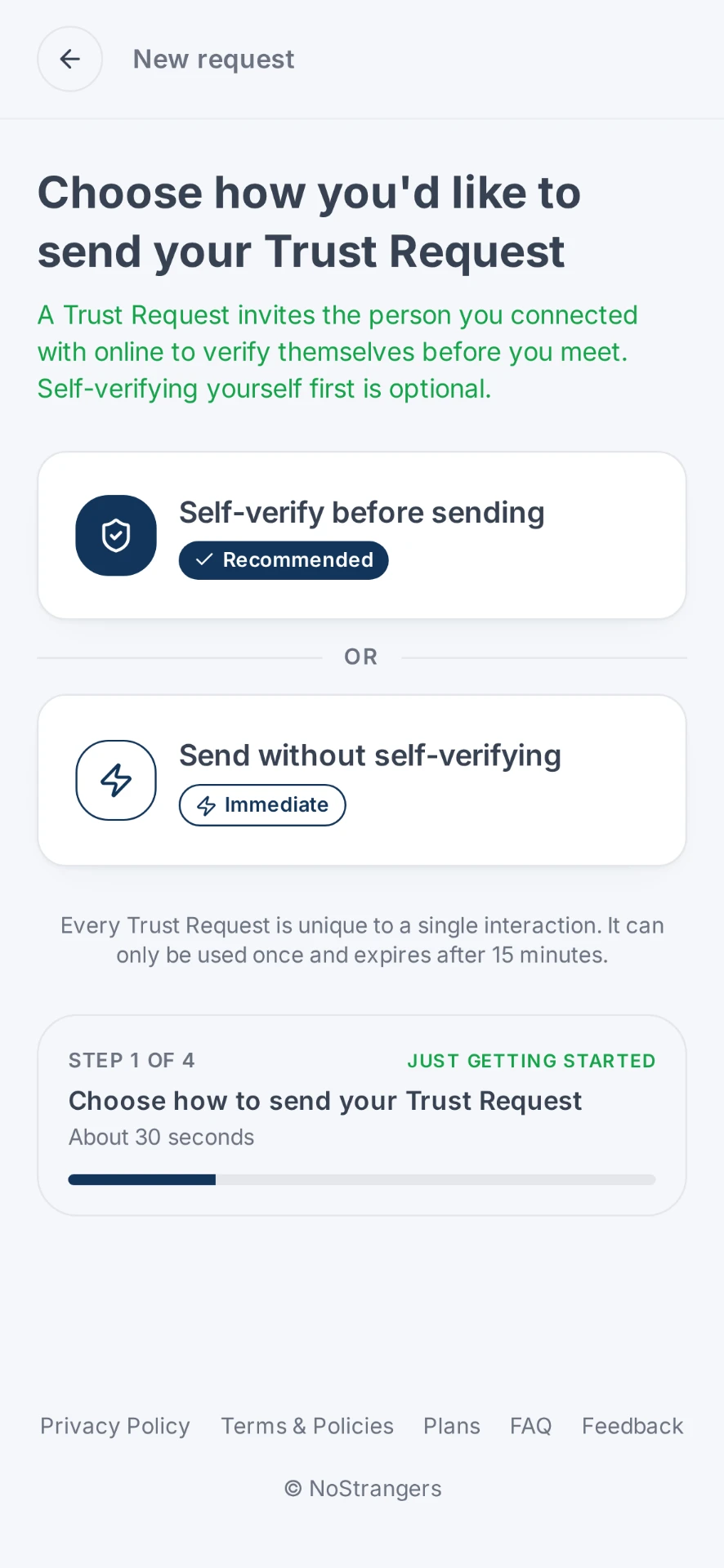
Send a Trust Request
Generate a unique code and paste it into the DM, thread or email you're already using.
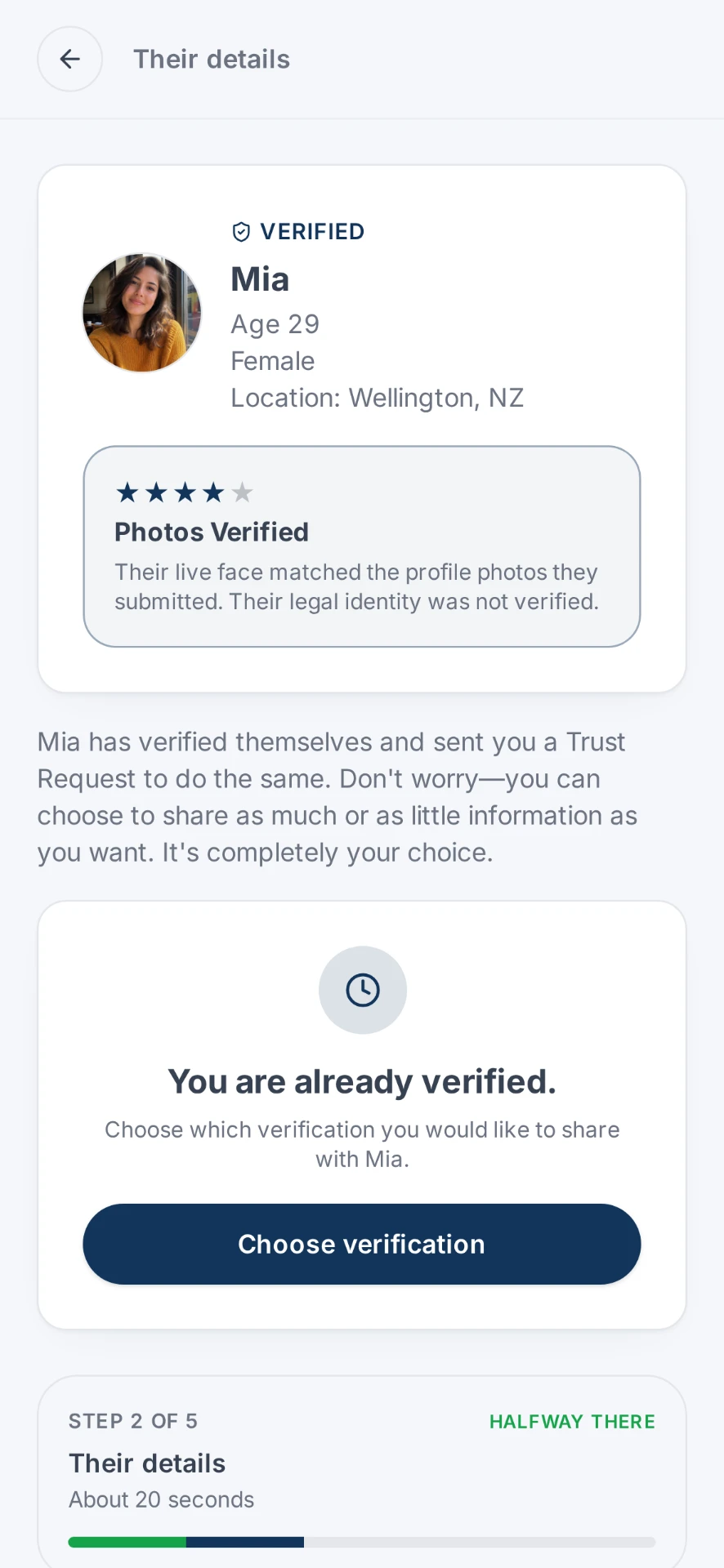
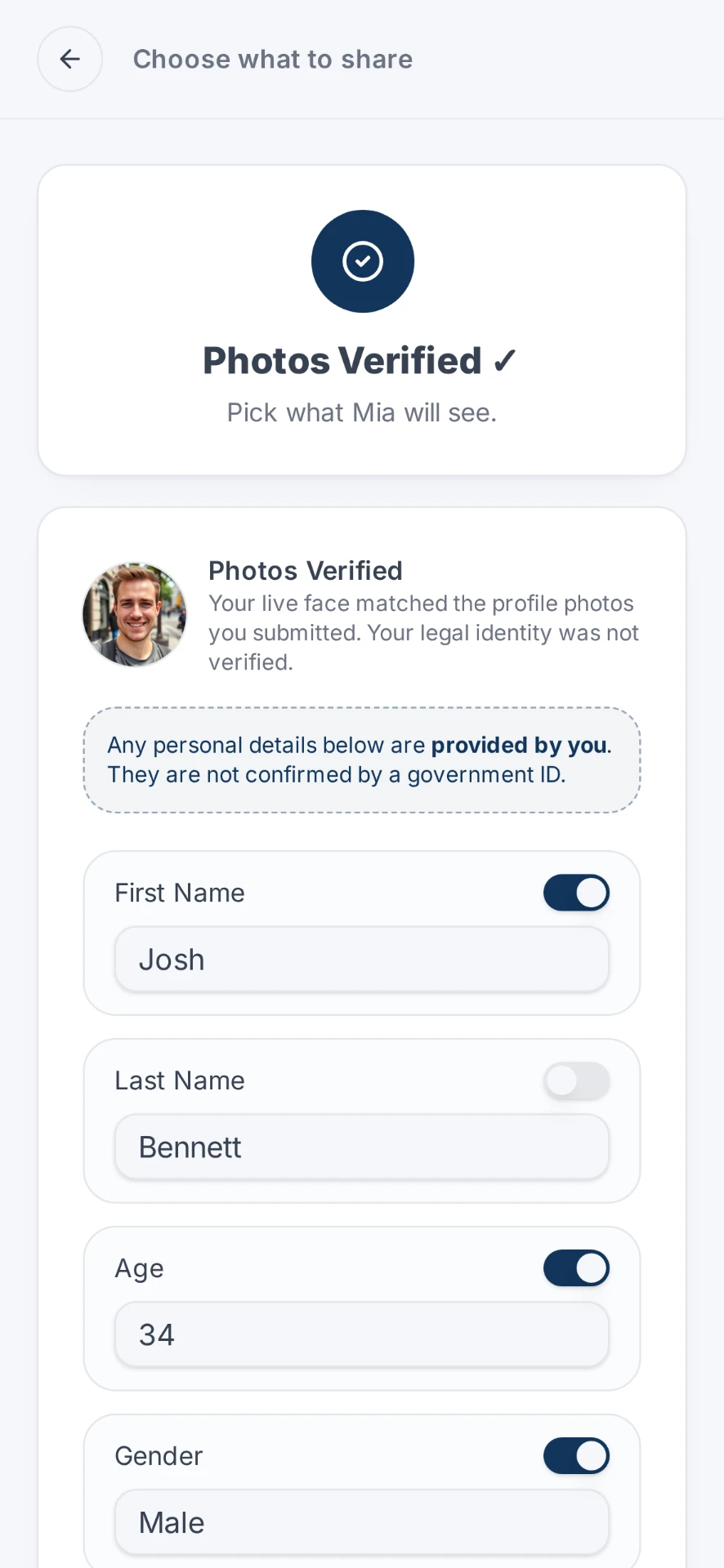
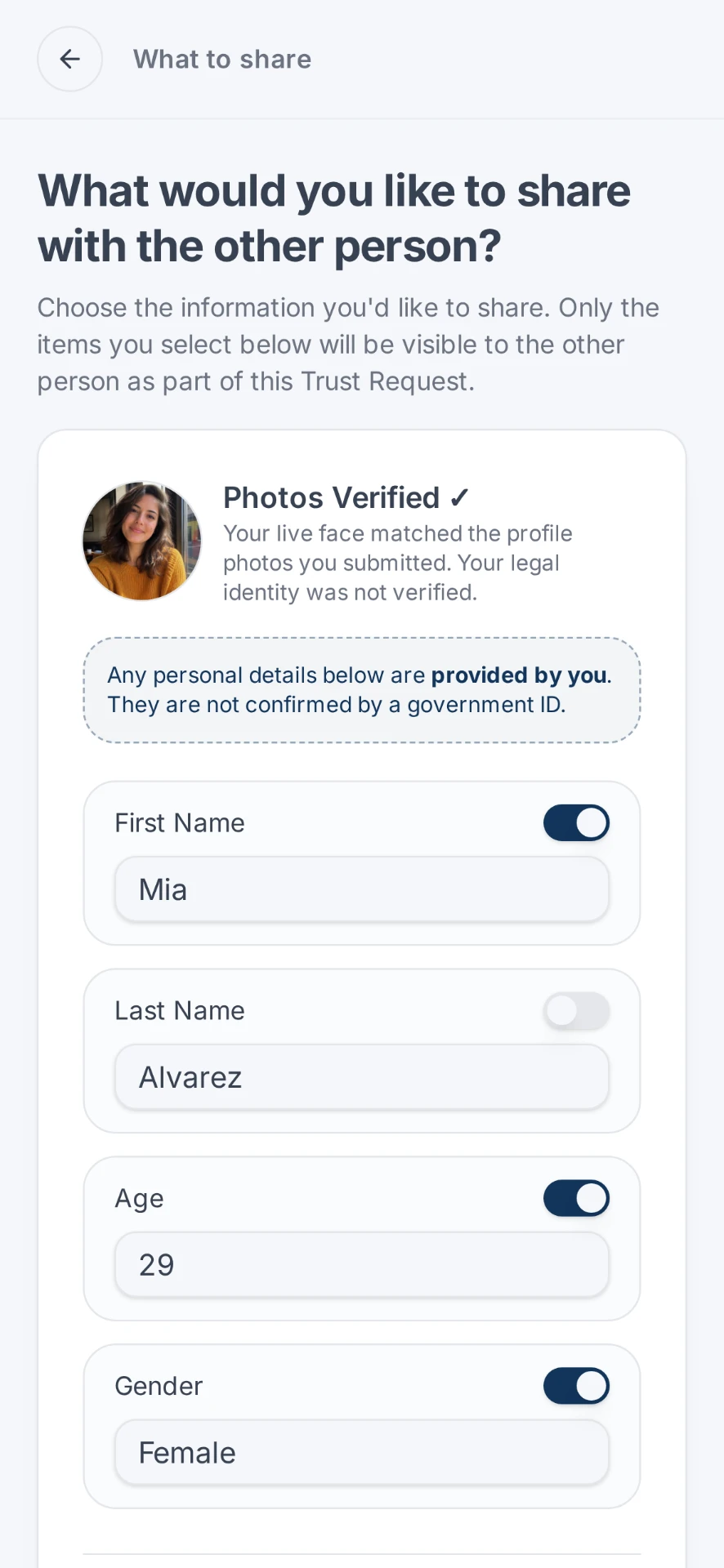
They verify and send back what they choose
The other person completes ID Verified, a live face check alongside their government-issued ID, and decides which details to return. Ask them first, wait for them to ask you, or agree that you'll both verify.
Then settle the deal
With who you're dealing with established, agree payment, inspection and handover on your own terms.
✓ Trust Established
Mia is now a NoStranger.
You can now view the information Mia has chosen to share.
★★★★★ IDENTITY VERIFIED
Mia Alvarez
Approx. connection location: Wellington, NZ
Age
29
Gender
Female
First name
Mia
Last name
Alvarez
Identity Verified
These details were verified from a government-issued ID and checked against authoritative records, with a live face check confirming the person completing the verification matches the ID.
You only see what they chose to share. This code can't be used again.
Privacy
Verified, without becoming public.
Only the match is shared. Your private information isn't. They don't see it. Neither do we.
Private deals often leak more personal information than platform ones: your real name, your bank details, your address, your phone number, all pasted into an ordinary chat. ID Verified keeps that step out of the thread. Each side chooses what to share and sees only the other's selection.
Nobody has to email a photo of their driving licence to a stranger, or exchange ID documents directly, to establish who they are.
More detail in our Privacy Policy.
When to use it
Direct deals where it makes a difference
Sold through a social-media group
A community page or interest group where the deal is arranged in comments and DMs.
Enthusiast forums and collector circles
Long-standing communities where trust is assumed from post count rather than confirmed.
Classified ads and noticeboards
Local listings with a phone number and no account history behind them.
A friend-of-a-friend introduction
Someone you've been referred to, which feels safer than it necessarily is.
Deposits and bank transfers
You're being asked to send money before you've seen the item or the person.
Handover at a home or car park
One of you is travelling to meet the other, often with cash or an expensive item.
Be clear
What a Trust Request adds to a private sale
A way to establish who each other is. Nothing about the goods, the ownership or the money.
It can help you
- Establish that a live person completed the verification process.
- With ID Verified, establish who that person is, using their government-issued ID and a live face check.
- Let either side ask the other to verify, or let both verify each other, with no platform standing in between.
- Give you a verified identity before you transfer money or share an address.
It doesn't
- Act as escrow, insurance or a payment protection service.
- Confirm that an item exists, is genuine or matches its description.
- Guarantee delivery, refunds or that a deposit will be honoured.
- Guarantee anyone's safety, or replace meeting sensibly and inspecting goods.
FAQ
Person-to-person sales questions
What counts as a person-to-person sale?
Any direct deal without a platform standing between you: a group post, a DM, a forum thread, a classified ad, a community noticeboard, or an introduction from a friend of a friend. There is usually no escrow, no ratings and no dispute process, just two people and an agreement.
How is this different from your Marketplace page?
Marketplace covers deals that originate on marketplace platforms, which provide at least some account history and payment protection. This page is about direct sales arranged in social media, forums, classifieds and private networks, where none of that exists.
How do I establish who I'm actually dealing with in a private deal?
Send a Trust Request before money moves, and ask for ID Verified. The other person completes a live face check alongside their government-issued ID, chooses what to share, and you see the result in about 90 seconds, with no account or app download needed. It confirms who they are; it doesn't mean you've exchanged ID documents with each other.
Does this protect my payment?
No. NoStrangers is not escrow, insurance or a payment service. It verifies people. For direct deals, still prefer meeting in a safe public place, inspecting goods, and avoiding irreversible payment methods with someone you've never met.
Does it confirm the goods are real?
No. It cannot confirm an item exists, is authentic, matches its description or will be handed over. For higher-value categories, see our Luxury Goods and Vehicle Sales pages.
Someone wants to deal by direct message only. Is that a red flag?
Not on its own. Plenty of honest sellers prefer it. What it does mean is that nothing about the deal is recorded anywhere except your own chat, which is exactly why an independent identity check is worth adding.
Can group admins or communities use this?
Members often adopt it themselves as a norm: verify before deals within the group. NoStrangers is person-to-person, so there is nothing for an administrator to install or manage.
Related use cases
Verify the person before the transfer.
About 90 seconds, in the same chat where you agreed the price.